Manufacturing Production Solutions

How to Succeed as a Woman in Manufacturing


Another International Women’s Day has arrived, and women are still underrepresented in so many business sectors.

While better represented here in manufacturing than in many other STEM industries, women still make up only 37% of manufacturing workers globally. As we know, a multitude of factors are responsible for this; girls being discouraged from STEM at a young age; the view of the sector as “for men”; discrimination against the women who do make it in the sector.

In order for manufacturing to be an attractive career path for women, we need to change the sector’s image and highlight the female role models blazing a trail in the industry. That’s why we’ve spoken to electronic solutions provider GTK’s HR Business Partner, Leanne Matthew (29), to understand her career journey and get advice for young women looking to progress in the sector.

Key quotes:

  • “A lot of the challenges I’ve faced in the past were in relation to not just being a woman but being a younger woman in leadership.”
  • “There’s a lot of age discrimination. I’ve heard people say “we need to hire more children into the industry, more people in their 20s” and that’s me - I'm not a child!”
  • “I’ve used these comments to drive my career and spur me on. I’ve used it to show them what I can do – and what all women, especially young women, can do!”
  • “Where you start your career is so important.”
  • “When you interview with a company, make sure you get a good feeling for them – ask the questions to understand how they see their employees, what progression opportunities they have and how they support their employees.”
  • “You can be as driven as you want, but if you’re at a business that’s holding you back and not supporting you, you’ll struggle to get to where you want to be.”
  • “Engagement starts at school age… get real representatives from STEM sectors who can illustrate what a career in manufacturing could look like into schools.”
  • “We need to change the male-dominated image of manufacturing and other STEM sectors.”
  • “Giving women in the sector a platform and showcasing role models helps promote manufacturing as a career path for women.”
  • “Businesses have a role to play when it comes to attracting female workers too. A lot of board members and senior managers in these businesses are likely to be older white men, and that can impact the policies and processes in place. It becomes a bit of a boy’s club.”

Can you tell us about your career so far and what you do in your role now?

I’m GTK’s HR Business Partner, which means I’m responsible for all aspects of employees’ journeys within the company, as well as all the processes and policies that go alongside that. I cover our sites in the UK as well as our Romanian site and the recently acquired Review Display Systems.

My job is to give the best possible experience to our employees and create a rewarding working environment. Employees are at the heart of GTK and should be for all businesses. Without them, you don't have a business. By giving them the best working environment possible, we create a happier, more motivated and more engaged workforce.

I sort of fell into HR – originally, I wanted to be a police officer and I trained as one before joining the Special Constabulary division of the Met Police. But after a few years I realised it wasn’t what I wanted to do, so I looked at my transferable skills and where they could be used – HR was a natural fit. I didn’t have any HR qualifications, so I started in an entry-level role and worked my way up from HR Administrator and HR Manager to where I am now.

I’ve worked in a few traditionally male-dominated sectors, from the police to food manufacturing and logistics, and now I’m back into manufacturing on the electronics side with GTK.

Have you faced any challenges as a woman in male-dominated sectors and as a woman in leadership?

A lot of the challenges I’ve faced in the past were in relation to not just being a woman but being a younger woman in leadership. A lot of these types of businesses are run by predominantly older men, and they assume a lack of capability. Sometimes, they’ll even treat you like a child.

You get the comments about your gender, or your age. Comments about you not knowing what you're doing. I’ve even had people say to me “well you're going to be off having children at some point”, which is something they’d never say to a man.

There’s a lot of age discrimination. I’ve heard people say, “we need to hire more children into the industry, more people in their 20s” and that’s me – I'm not a child! Then people have used my age against me when progressing my career. When I was seeking a promotion and a pay rise in a previous role, I was told no because “you’re doing better than most people your age”; what I receive in my job shouldn’t be based on other people’s progress. It should be based on my worth, my skills and how hard I’ve worked.

One thing I can say is that I haven’t experienced any of this at GTK – we have a lot of women in senior roles, including myself, and I’ve found it’s one of the most inclusive work environments I’ve been in.

How have you dealt with these challenges?

I’ve used these comments to drive my career and spur me on. I’ve used it to show them what I can do – and what all women, especially young women, can do! We shouldn't be defined by our gender or our age. We should be defined by what we can achieve and our capabilities.

These comments are frustrating, but instead of seeing them as a restriction, they’re my driver. This is my chance now to go out there, prove them wrong and show what women can do.

I think my experience in the police force has helped too. I was taught the skills that would give me a thicker skin, a harder shell. My training taught me how to respond to all types of situations and feedback well – you need to consider and think about what’s happening before you respond.

What advice would you give for young women aspiring to be leaders or work in STEM sectors?

Where you start your career is so important. If you’re looking to enter a more generalist role like HR, marketing, finance and so on, remember that these roles are available in all sectors. Don’t limit yourself.

When you interview with a company, make sure you get a good feeling for them – ask the questions to understand how they see their employees, what progression opportunities they have and how they support their employees. If I hadn't got into a company that helped me grow and develop, with really supportive managers and leaders early in my career, I wouldn't be where I am today.

If you find you’re not in the right company, sometimes you need to make the difficult decision to move on and find the right place. If you're somewhere where they're holding you back, it’s going to be a hindrance to your development. In terms of support, I've always been around strong female role models, and that’s been invaluable to my career. They’ve looked to develop me, had career conversations with me – that kind of environment will allow you to progress. I’m surrounded by strong female leaders at GTK now and it creates an environment where women are supported and where we can really shine.

You can be as driven as you want, but if you’re at a business that’s holding you back and not supporting you, you’ll struggle to get to where you want to be.

How can we get more girls and women interested in STEM?

Engagement starts at school age. Get people from STEM businesses to come in and give talks at varying ages – from late primary school to before students choose their GCSEs. And don’t just get people in from fancy banks and businesses like Google – get real representatives from these sectors who can illustrate what a career in manufacturing could look like.

We also need to change the male-dominated image of manufacturing and other STEM sectors. If you Google them, and even look at company websites, you’ll get images of men in high-vis and hard hats, and that’s only a tiny proportion of the sector’s workforce and output. Manufacturing is becoming more technology-based now, and you have essential roles in quality and procurement and back-office roles like HR and marketing.

Giving women in the sector a platform and showcasing role models helps promote manufacturing as a career path for women. Young people need to know that they can go into manufacturing, because it's not just wearing a high vis and a hard hat, there's lots of other doors that can open and lots of other benefits.

Businesses have a role to play when it comes to attracting female workers too. A lot of board members and senior managers in these businesses are likely to be older white men, and that can impact the policies and processes in place. It becomes a bit of a boys’ club.

Maybe there’s been no consideration for diversity or inclusivity. And that goes from hiring women to having us work there. Policies like flexible working and parental leave will be attractive to women who do have children, and things like unconscious bias training can help to eliminate discrimination within the workplace. If these benefits and training opportunities aren’t taken into consideration, of course a lot of women would think, “why would I work there when I can go to a business that will support me?”

GTK has invested in its HR function by bringing me on board, and I’ll be driving a lot of these policies within the business. We’ll be undertaking unconscious bias training to make sure we can provide a safe environment for women and people from all backgrounds, and I’ll be formalising some of our processes that help us to hire and develop talented women.

A lot of people might say that they don’t have a need for these policies and training plans within their business, perhaps because they don’t have many or any women in the business. But if you want to attract talented women, you need to support them. Businesses are potentially missing out on a massive talent pool because of this!
Why The Future Of Industrial Automation Needs Tsn

There is a lot of hype about one of the most significant and transformational developments in standard Ethernet technology – Time-Sensitive Networking (TSN). This is an enabling technology for industrial communications that can help to realise IT/OT convergence and lead to substantial enterprise-wide improvements. In effect, TSN and TSN-compatible devices are key to setting up futureproof Industrial Internet of Things (IIoT) frameworks that enhance productivity, flexibility and responsiveness.

Jeremy Shinton, Product Manager for Edge Computing Technologies at Mitsubishi Electric, looks at how TSN-compatible automation components can create agile and futureproof factories.

TSN is an innovative technology at Layer 2 (Data Link) of the Open System Interconnection (OSI) reference model for communications. Defined by the IEEE 802.1 standards, it provides key functions to make Ethernet deterministic by design. This enhances industrial communications technologies, helping to coordinate network traffic as the volume of data continues to increase with the convergence of IT/OT.

With TSN, all devices on a network are synchronised. This minimises the likelihood of jitter and prevents any subsequent delay in high-speed data transfer. In addition, TSN supports the prioritisation of urgent and regular data, by reserving timeslots for both. During these intervals, only scheduled or time-critical traffic is transmitted, without any interference. As a result, network overload can be prevented, minimising the risk of data loss.

In practice, these capabilities hold the key to creating futureproof IIoT applications. Providing accurate methods to prioritise the transmission of urgent or mission-critical information, such as control data from the shop floor, allows different types of traffic to be merged on the same TSN-compatible network. The result is flattened, simplified architectures with limited capital expenditure (CAPEX).

These architectures can also increase uptime by streamlining the identification and elimination of network errors. In addition to this, businesses can set up a more flexible infrastructure, where TSN-compatible devices can be easily added, removed or reconfigured.

What built-in determinism offers

The convergence of IT and OT is at the core of future-oriented IIoT applications and the ability to transmit multiple information types and protocols, whilst maintaining low jitter and latency, is essential. By creating a TSN-compatible, unified network of automation devices with TSN functionalities, IT and OT networks can be combined to operate over a converged Ethernet architecture.

This, in turn, enables companies to benefit from the data-driven knowledge generated by different parts of an enterprise as they obtain holistic actionable insights into manufacturing processes. Furthermore, they can create decentralized decision-making strategies to help different parts of the company access relevant data from across the organisation to obtain key process information. Ultimately, the in-depth understanding that is generated can be leveraged to improve KPIs, leading to enhanced performance, productivity, efficiency and end product quality.

TSN offers an unprecedented opportunity for companies, enhancing industrial communications and providing the tools to realise forward-looking smart manufacturing strategies. The implementation of TSN solutions in network technologies and automation devices is therefore essential to help businesses to succeed in their digital transformation strategies.

Businesses can adopt TSN-compatible devices now

Mitsubishi Electric recently released TSN interfaces across its automation systems product range, providing communications technology that combine gigabit Ethernet bandwidth with Time-Sensitive Networking, CC-Link IE TSN. These enable both machine builders and end users to make the switch to TSN or upgrade their current systems.

The range of products offered by Mitsubishi Electric includes PLCs, servo amplifiers, robots, HMIs, I/Os, variable speed drives and CNCs. By adopting Mitsubishi Electric components that incorporate CC-Link IE TSN, companies can rely on proven technologies that realise the full potential of Time-Sensitive networking to create agile and futureproof factories.

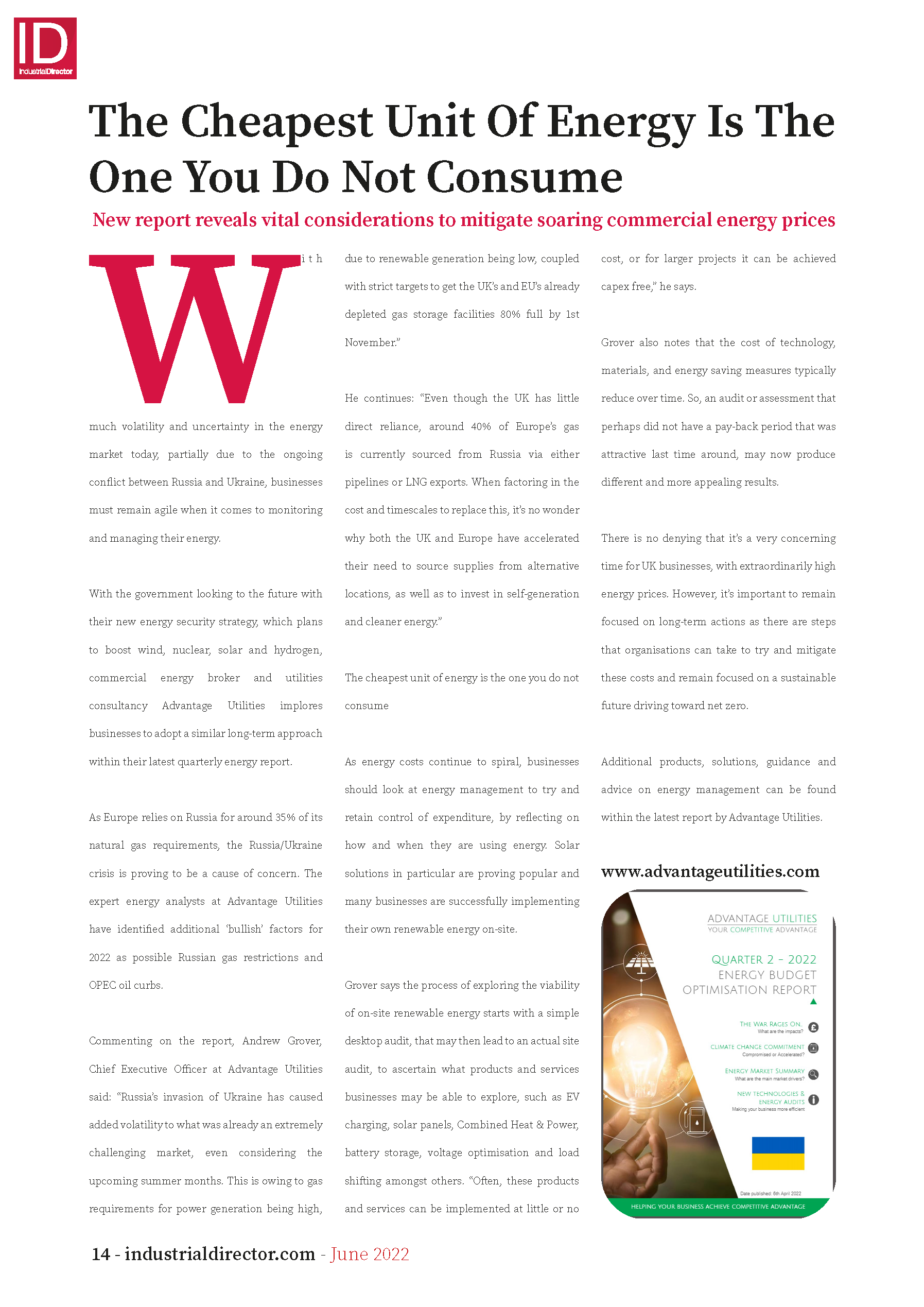
The cheapest unit of energy is the one you do not consume

New report reveals vital considerations to mitigate soaring commercial energy prices

With much volatility and uncertainty in the energy market today, partially due to the ongoing conflict between Russia and Ukraine, businesses must remain agile when it comes to monitoring and managing their energy. 

With the government looking to the future with their new energy security strategy, which plans to boost wind, nuclear, solar and hydrogen, commercial energy broker and utilities consultancy Advantage Utilities implores businesses to adopt a similar long-term approach within their latest quarterly energy report.

As Europe relies on Russia for around 35% of its natural gas requirements, the Russia/Ukraine crisis is proving to be a cause of concern. The expert energy analysts at Advantage Utilities have identified additional ‘bullish’ factors for 2022 as possible Russian gas restrictions and OPEC oil curbs.

Commenting on the report, Andrew Grover, Chief Executive Officer at Advantage Utilities said: “Russia’s invasion of Ukraine has caused added volatility to what was already an extremely challenging market, even considering the upcoming summer months. This is owing to gas requirements for power generation being high, due to renewable generation being low, coupled with strict targets to get the UK’s and EU’s already depleted gas storage facilities 80% full by 1st November.”

He continues: “Even though the UK has little direct reliance, around 40% of Europe’s gas is currently sourced from Russia via either pipelines or LNG exports. When factoring in the cost and timescales to replace this, it’s no wonder why both the UK and Europe have accelerated their need to source supplies from alternative locations, as well as to invest in self-generation and cleaner energy.”

The cheapest unit of energy is the one you do not consume

As energy costs continue to spiral, businesses should look at energy management to try and retain control of expenditure, by reflecting on how and when they are using energy. Solar solutions in particular are proving popular and many businesses are successfully implementing their own renewable energy on-site.

Grover says the process of exploring the viability of on-site renewable energy starts with a simple desktop audit, that may then lead to an actual site audit, to ascertain what products and services businesses may be able to explore, such as EV charging, solar panels, Combined Heat & Power, battery storage, voltage optimisation and load shifting amongst others. “Often, these products and services can be implemented at little or no cost, or for larger projects it can be achieved capex free,” he says.

Grover also notes that the cost of technology, materials, and energy saving measures typically reduce over time. So, an audit or assessment that perhaps did not have a pay-back period that was attractive last time around, may now produce different and more appealing results. 

There is no denying that it’s a very concerning time for UK businesses, with extraordinarily high energy prices. However, it’s important to remain focused on long-term actions as there are steps that organisations can take to try and mitigate these costs and remain focused on a sustainable future driving toward net zero. 

Additional products, solutions, guidance and advice on energy management can be found within the latest report by Advantage Utilities.

Predictions for the manufacturing industry in 2022 and beyond

Jason Chester, Director of Global Channel Programs, InfinityQS, provides his thoughts on what we can expect to see from the manufacturing industry over the next 12 months and beyond.

2021 was a challenging year for the manufacturing industry with the global chip shortage and ongoing Covid pandemic having a severe impact on manufacturers. Despite this, there is optimism for 2022. In December 2021 it was revealed by IHS Markit/CIPS UK Manufacturing PMI that manufacturing output, new orders and employment all rose, resulting in a strong end to the year. But will this momentum continue onto this year and what can we expect to see over the course of 2022 and beyond? 

Prediction #1 – Pandemic Response Becomes Post-Pandemic Strategy

The last two years has taught us two things. First, that the impact of the pandemic will be with us for some time to come, perhaps indefinitely.  Second, that the proverbial black-swan events can, and indeed will, happen eventually.  That means we not only need to make permanent some of the rapid changes recently made, and make them more robust and operationally sound, but we need to rethink many parts of our business operations.  How flexible are they?  How robust are they?  And how are they able to support other future events that may have unprecedented impact on the business?  Not just in terms of another pandemic, but from other events such as natural disasters and economic, for example.

Therefore, 2022 will be the year in which businesses of all sizes and across all industries will move from the firefighting era of the pandemic-response to an era of operational change and restructuring in the form of a post-pandemic strategy.

Prediction #2 – Cloud Computing/SaaS and the New Normal

Over the last two to three decades, Cloud Computing and Software-as-a-Service (SaaS), has been slowly increasingly in momentum in adoption with the curve becoming steeper and steeper.  That is because more and more IT departments, CIOs, CFOs, CEOs and many other disciplines are now realizing the extraordinary business benefits of Cloud/SaaS over traditional in-house client-server IT architectures.  Coupled with advances and maturing of the core technologies it is now becoming a ‘cloud-first’ strategy for most organisations when turning to new technology capabilities.

But again, the pandemic has had a role to play in that recent acceleration to a cloud-first strategy.  Supporting remote workers through anytime, anywhere access to critical business processes and information was solved largely through the rapid deployment and migration to cloud-based solutions.  Those companies that were previously reluctant to make the leap, due to either misunderstanding or lack of understanding, often had their hands forced.  As a result, legacy systems are a high priority for digital transformation and in particularly with a view to cloud/SaaS-based alternatives.  

I believe that 2022 will represent the ‘tipping point’ in cloud adoption with a cloud-first strategy becoming the standard default position for most legacy renovation projects and the major technology consideration in a post-pandemic strategy.

Prediction #3 – Tribal Knowledge Becomes Codified

In many industries, and manufacturing is certainly no exception, people build up significant levels of skills, knowledge and experience that pertain to their roles.  But most of that tacit knowledge is stored mentally and rarely documented or codified.  For example, an operator may hone a particular skillset over many years in a particular process area using a particular piece of machinery.  Quite simply, she just knows how to perform the tasks correctly and get the best out of the equipment and resources.  But what happens when she, or her immediate peers, are no longer available (such as from the impact of the Covid pandemic or other events) to perform those tasks?

2022 will be a pivotal year in this regard as organisations begin to move more aggressively towards codifying what is currently highly tacit, tribal knowledge. Not only using solutions such as workflow and business process management, but also emerging solutions in areas such as predictive and prescriptive analytics as well as leveraging machine learning and AI techniques. 

Prediction #4 – Sustainability Accelerates Digital Transformation Momentum 

The driving force behind digital transformation is shifting with sustainability beginning to take centre stage. Organisations across every industry and of all sizes are now recognizing the responsibility and scrutiny being placed on them by governments, consumers, and society at large to become much more environmentally responsible in their business activities.  From waste, resource usage, carbon emissions and recycling, for example, organisations will increasingly turn to digital solutions to optimise efficiency and productivity and this significantly reducing unnecessary environmental impact.

Prediction #5 – Industrial Automation Makes Way for Information Automation

Information is rapidly becoming the next battle ground in the war on efficiency and productivity.  We now have the technology capabilities to effortlessly capture data in real time, analyse that data automatically and in real time using sophisticated algorithms, and present the result of that analysis in highly visual and intuitive visualizations.  This makes decision making much quicker and more effective, enabling critical decisions to be made in real time to ensure that industrial processes are running optimally and where that is not the case, enable us to better predict when and where problems are most likely to occur, before they impact on efficiency and productivity.

As industrial automation delivers ever diminishing returns as much as the low hanging fruit has been harvested and now has become commonplace, I believe that 2022 will see information and cognitive automation within industrial environments become much more prevalent.

Share This

1 2 3 4 5 6 7 8 9 10 11 11