Manufacturing Production Solutions

Automation Takes Centre Stage

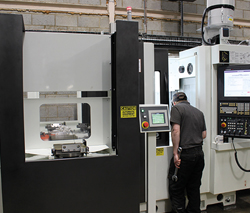
Now in its 17th year of business, Hi-Spec Precision Engineering Ltd has evolved from a small start-up business to an established subcontract manufacturer that has fully embraced the latest CNC technology and more recently automation technology to drive growth and productivity. 

The Market Overton company has evolved over the last decade to encompass everything from conventional and CNC machining to grinding, lapping, honing, welding and fabrication, hydraulic pressure testing and assembly with 14 CNCs now on the shop floor. As part of the journey, Hi-Spec has invested in automation. The first move was investing in barfeed equipment for its turning centres, more recently robotic loading/unloading for machining centres and now, a 10-pallet Kitamura Mycenter HX250iG horizontal machining centre from Dugard.  In the last four years since starting the automation journey, Hi-Spec has lost staff due to retirement and now, the 8-employee business is more productive than ever. Despite having employees in non-production roles such as admin, inspection and fabrication, the turnover to staff ratio per employee was once 8%,  this is now 16% and the arrival of the multi-pallet machine will only increase this profitability further. 

Additive Casting® Enables

Traditional metal casting has been around for centuries and has, over time, evolved to be the predominant production method for metal parts. Benefits of metal casting include scalability, the ability to cast a wide selection of metals and cost competitiveness. On the other hand, traditional casting requires expensive investment in tooling and is very limited when it comes to part complexity. Until now.  We meet Anja Stolte, winner of Women in Innovation Award, who is combining 3D printing with traditional casting to revolutionise additive manufacturing. By combining the best of 3D printing with traditional casting, Anja is able to manufacture complex metal parts through what she describes as Additive Casting®

Her innovative approach uses industrial 3D printing to produce moulds from which she can cast parts using virtually any kind of metal. The technique eliminates the need for tooling and delivers high quality and complex products at a lower cost than current techniques. 

Digital Solutions Minimise Downtime

The potency of remote maintenance and customer assistance – especially harnessing the power of smart’ phones - has never been demonstrated more forcibly than during the past year when the coronavirus pandemic has forced lockdowns across the globe. However, the United Grinding Group has increasingly used technology to support its worldwide customer base and, in many cases, keep machines running with minimal downtime.

According to United Grinding Group company Walter Ewag UK, the Group’s Digital Solutions embrace three main offerings for the users of member companies’ wide range of grinding solutions; Production Monitor, Service Monitor and Remote Service. The first two help customers keep track of production - for example, highlighting when maintenance work is required and where/when problems may arise in production. Remote Service is designed to help support the help desk over a data connection. But why use this route rather than simply ‘phoning the help desk?

Productivity & Efficiency

As industry in the UK and Ireland emerges from the pandemic lockdown, improvements in production efficiency will be essential to maintain competitiveness in a global marketplace. 

Many original equipment manufacturers and the subcontractors in their supply chains will be pitching for sales in an environment characterised by fewer business opportunities in the short term, suppliers hungry for work and smaller profit margins. Only the most productive companies will survive.

Share This