Cobots hold the promise of increasing the efficiency and quality of human work, bringing greater reliability, consistency and precision to a variety of manufacturing and assembly operations. However, do these potential benefits hold true for all users?
Oliver Giertz, Product Manager for Servo/Motion and Robotics at Mitsubishi Electric Europe B.V, Factory Automation EMEA, comments on cobot trends and how these correspond with end user requirements.
Introduced only relatively recently, collaborative robots (cobots) today represent the fastest growing area of robotics. By eliminating the need for protective fences, cobots offer space-saving installation alongside people – a key consideration on many brownfield sites where floor space is at a premium. Simple programming and easy system configuration make them easy to deploy and redeploy. And there is the potential to handle not only the simple and repetitive tasks to increase production efficiency, but also the flexibility and adjustability to tackle more specialist tasks.
The manufacturing industry makes stringent demands on automation systems. For cobots, that can mean a requirement for some very specific features. This raises the question, ‘is it always possible to combine the simplicity of programming and set-up that many cobots purport to offer with the requirements for precision that many applications demand?’
It was not unusual for end users to find that the answer to the questions was ‘no’. This can limit the cobot’s applicability to a narrow range of tasks, potentially also limiting opportunities for redeployment, and ultimately impacting on the return on investment.
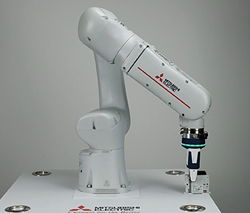
With the MELFA ASSISTA cobots, Mitsubishi Electric has built on its experience in industrial robots to develop a cobot range that addresses the real world challenges of different applications and sectors. It recognises that simple control and ease of programming must be taken as a given, but without impacting on precision. Mitsubishi Electric has developed a new hand-guided teaching strategy, where the cobot arm is simply moved to the desired position. Operators then press a single button on the teaching panel on the arm, and the position is added to the robot program. Combining this with an intuitive, touch-enabled, graphical programming tool – RT VisualBox – makes it easier to build sophisticated applications without any programming knowledge.
So, the verdict. With these features, cobots offer not only optimised assistance for the human workforce, but also the greatest possible return on investment.