Manufacturing Production Solutions

Manufacturers rethink role of video tech as operational pressures grow

Research for first issue of ‘In focus’ series from Axis explores UK manufacturing challenges and why cost and quality pressures are driving demand for greater operational insight.

Axis Communications, a leader in network video, found in a survey of 600 UK manufacturing decision-makers in Q2 2026 that 39% say operational efficiency and productivity will be the greatest future value of security systems ahead of security and incident prevention at 33%. This reflects a growing demand for better visual intelligence to help control the industry’s dominant pressure of rising costs, cited by 57%.

These are the findings of a new evidence-led series using independent research and expert analysis to examine how visual intelligence can support the digital transformation of key sectors. In focus: a spotlight on manufacturing by Axis explores how video data can help manufacturers add context to operations, close the visibility gap, and support smarter, safer and more efficient manufacturing.

Over one quarter of respondents said reducing cost would be the top priority to solve with better insight, and 45% see significant or some potential for network cameras beyond physical security. Yet while 96% use security technology for security and incident prevention, only 18% use it for operational efficiency and productivity currently.

The conclusions also point to a maturity gap. While visual intelligence can help teams find, understand and act on the causes of cost, including waste, rework, downtime, process variation, unsafe behaviours, manual inspections and delayed investigations, only 16% say security technology data is fully integrated into operational decision-making - 42% say it is used in some decisions and 27% say it is not used at all.

Key findings:

  • Cost is the dominant pressure: 57% of UK manufacturers cite rising operational costs as a major operational challenge
  • Insight is needed to control cost: 26% say reducing operational cost is the area where better operational insight could have the greatest immediate impact
  • Visual data has clear operational potential: 45% see significant or some potential for network cameras or visual data to improve operations beyond physical security
  • Security tech is still underused operationally: 96% use security technology for security and incident prevention, but only 18% use it for operational efficiency and productivity
  • Manufacturers expect a shift: 39% say operational efficiency and productivity will be the greatest future value of security systems over the next 3-5 yrs, ahead of security and incident prevention (33%)
  • Integration for decision-making is limited: Only 16% say security-tech data is fully integrated into operational decision-making - 42% use the data in some decisions while 27% do not use it at all.

Gabriele Mangiafico, Business Development Manager EMEA, Axis Communications, says, “What is clear from the research is that for manufacturing to become truly smarter, it needs more context to better understand what is actually happening on the factory floor. The main challenges given by manufacturers are context-heavy problems, such as reducing waste, where visual intelligence can connect operational data to real-world events, helping teams investigate faster and act with greater confidence. This points to a strong shift. While security technology is still overwhelmingly viewed through a traditional protection lens, it will move from the control room into the operational core of manufacturing in the near future.”

Health and safety is another area where visual intelligence can help manufacturers shift from forensic review to proactive prevention. While only 14% currently use security technology for health and safety improvement, 37% of Health and Safety respondents were unsure or have not considered the potential of visual data beyond security. Monitoring PPE use, verifying access rights to restricted or hazardous areas, detecting non-compliance and triggering visual or audible alerts are all strong use cases where network cameras can provide the real-time context needed to reduce risk before it becomes an incident.

Linn Storang, Regional Director, Northern & Eastern Europe, Axis Communications, commented, “The smart factory will not be built on data alone. Manufacturers also need context, and network camera technology can provide a vital layer of visual intelligence that many organisations have not yet fully explored. By connecting existing video data to operational decision-making, manufacturers can move beyond post-incident review and use visual insight to support productivity, quality, safety and resilience in real-time.”

Explore more on Axis.com: ‘In focus: a spotlight on manufacturing by Axis’


Toward EN 17975 compliant Lockout/Tagout

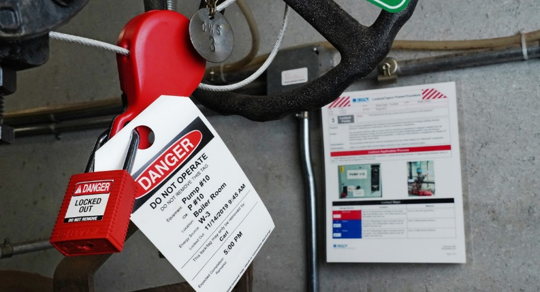
The recent European Norm 17975 addresses ‘grey zone’ energy-related risks during machine and pipeline interventions and proposes a task based framework for safe and efficient work. The norm can further increase the safety and efficiency of Lockout/Tagout programmes in a wide range of industries.
industries.jpeg

A task based safety framework

10%-15% of fatal workplace accidents in Europe’s industries are related to maintenance operations according to data from the European Agency for Safety and Health at Work. Many of these result from underestimating risks involved in specific tasks such as machine greasing, sensor adjustment or a quick cleaning that are not always seen as ‘maintenance activities’. They are kept outside the scope of Lockout/Tagout programmes even though workers are exposed to similar risks. European Norm (EN) 17975 addresses these grey zone risks by using task based risk analyses as a starting point.

“EN 17975 does not require an energy zero state for every machine or pipeline during every intervention”, said Mustafa Ekseri, EMEA Safety Engineer at Brady Corporation, a supplier of quality Lockout/Tagout solutions. “Not having to halt an entire production line for every intervention can save valuable time - if it is possible in a safe way. To achieve this, EN 17975 proposes a layered approach based on risks related to specific tasks on specific machines and pipes. These risks are to be highlighted in a risk analysis. In absence of a risk analysis, machine zero energy states remain the safety standard. In that sense, EN 17975 builds on ISO 14118 by providing more options for compliance with European workplace safety legislation. Impacted activities can be defined using EN 17007 and EN 13306 and are also listed in EN 17975.”

Risk analysis guidance

With machine and pipe intervention safety hinging on identified risks, industries will need thorough task-based risk analyses. Guidance can be found in other standards. “ISO 12100, primarily intended for machinebuilders to take into account their customers’ workplace safety, can be used as a basis for machine intervention risk analyses. ISO 31000 provides guidelines for managing risk in general, including 8 core principles, a framework and a process.”
preocess.jpeg

“EN 17975 proposes 6 steps to analyse the risk in any machine intervention task, starting with the identification of the task, all the way to a feedback loop for continuous improvement. That includes a thorough energy source inventory and identification. The standard also requires a risk analysis update before applying Standard Operating Procedures, and during maintenance activities. In addition, EN 17975 advocates clearly identified degraded situations that may deviate from the standard risk assessment.”

Task-based isolation

EN 17975 uses a task based risk approach that was captured earlier in the French norm X60-400. Based on a task risk analysis, the European Norm proposes 4 types of risk control processes:

  • Neutralisation: a process that, through design of the control systems, shuts down an item of equipment so that a list of predetermined tasks can be conducted in safety.
  • Standard isolation: a process that results in the removal – by locking in position a single or double isolating device – of all energies & fluids where the presence, accidental retention, unexpected appearance does not have hazardous consequences for workers, the environment, and items.
  • Reinforced isolation: a process that results in the removal – by separation or by a combination of isolating and opening devices (e.g. valve, tap, etc.) – of all energies & fluids where the presence, accidental retention, unintended appearance does not have hazardous consequences for workers, the environment, and items.
  • Specific provisions: a process that results in the implementation of organisational or technical measures enabling observation, diagnostics, testing activities and work on settings for the item in service to be carried out safely, with energies & fluids present.

“All 4 risk control processes require an inventory of energies and fluids per machine with their effects on people, property and the environment, a mapping of the isolating devices and an identification sheet of energies, fluids, components and lockout

devices. It also requires a shared risk assessment grid and process. EN 17975 describes the aim, application conditions, type of activities and other relevant factors for each of the 4 risk control processes.”

Lockout/Tagout guidance

Complying with EN 17975 requires a human, organisational and technical approach, all of which are outlined in the norm.

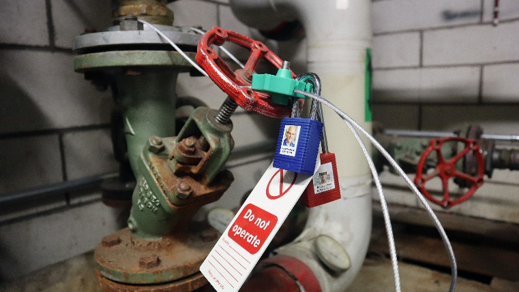
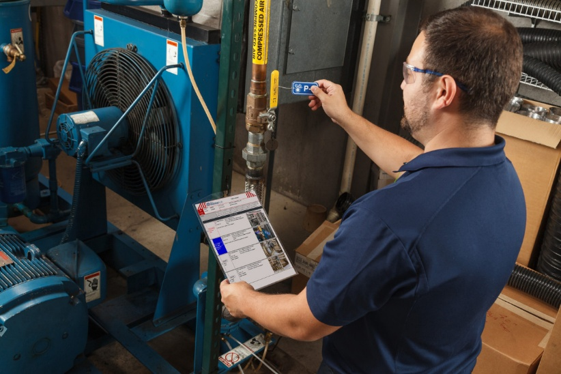
EN 17975 identifies 9 steps to carry out reinforced and standard isolations by Lockout/Tagout of energies and fluids. Steps involve separation of energies and fluids, isolation, lock out, tagout, identification, dispersion of energies, check, contain and inspect. “The ‘check’ step in EN17975 is already widely known in the industry as the ‘Tryout’ in Lockout/Tagout/Tryout or LoToTo. It is a vital step to help make sure that measures are implemented correctly and that they are still effective.”

“Brady safety engineers can help industries implement isolations by writing machine- and task specific lockout procedures. These can include all 9 steps from EN 17975, and they must be based on company task risk assessments. In addition, we can offer the right Lockout/Tagout tools for procedure compliance, set up a hands-on demo by locking out a specific machine, and provide training to relevant employees. Alternatively, a gap analysis can be made that identifies steps to be taken from the current state to arrive at compliant, best practice Lockout/Tagout.”
log_out.jpeg

Impact on existing safety programmes

EN 17975 is not a legal requirement. “The standard however considerably facilitates compliance with EU workplace safety legislation. It sets a clear expectation for any machine intervention: if no risk analysis for the task is available, a machine zero energy state is required.”

“Because many safety programmes already involve complete machine isolation from every energy source, for every task, it is likely that the new norm will impact existing Lockout/Tagout-programmes. Based on the risk analysis, machine zero energy states may not be needed for every type of intervention.”

“Adversely, some tasks that were considered ‘small and safe’ may unveil more risk after a thorough risk analysis. This means a single machine could have several Lockout/Tagout procedures. The right procedure can be included with, or communicated via a QR-code on a work permit for example.”

“Some forms of automated safety may not be sufficient for every task without an underlying risk analysis. Take a safety cage for example, equipped with sensors that deactivate moving machine parts the moment someone enters the cage. Do these nullify any residual energy that may pose a risk? Is gravitational, and other potential energy taken into account? The goal of EN 17975 is to prevent accidents, and to avoid a false sense of safety that does not provide any real protection.”

With the European Norm 17975, industries in Europe can now rely on a common standard for compliance with EU and national safety legislation that involve risk control processes of energies and fluids in maintenance activities. The norm is or will be implemented by the national standards organisations of Austria, Belgium, Bulgaria, Croatia, Cyprus, Czech Republic, Denmark, Estonia, Finland, France, Germany, Greece, Hungary, Iceland, Ireland, Italy, Latvia, Lithuania, Luxembourg, Malta, Netherlands, Norway, Poland, Portugal, Republic of North Macedonia, Romania, Serbia, Slovakia, Slovenia, Spain, Sweden, Switzerland, Türkiye and the United Kingdom.

Get the Brady EN 17975 Lockout/Tagout webinar recording

Go from zero machine energy to zero intervention risk with task based Lockout/Tagout, driven by the European Norm 17975. Get your copy of the EN 17975 webinar from an experienced, worldwide Lockout/Tagout solution provider.

Discover more about:

  • the unique European framework EN 17975 provides to achieve safety and efficiency
  • how EN 17975 focuses on task-based safety, rather than machine zero energy states
  • how EN 17975 can be used to address ‘Grey zone’ risks
  • 4 risk-based energy isolation levels presented by EN 17975
  • 6 steps to control risks
  • Lockout/Tagout procedure writing
  • Lockout/Tagout device and padlock types

Get the webinar recording now >

Draw inspiration from our free guidebook on how to best implement Lockout/Tagout. Download the free guide >

Mustafa Ekseri works as a Safety Engineer for Brady Europe, Middle East and Africa. He is involved in planning, writing procedures and rolling out Lockout/Tagout programmes at manufacturing and logistics workplaces throughout Europe. He is a Prevention Advisor Level 2, a Belgian legally regulated curriculum that equips professionals to handle safety and health risks in businesses.

Flir Thermal Imaging Helps Reveal Hidden Text in Ancient Herculaneum Papyri

Flir thermal imaging technology is helping researchers in Italy unlock hidden text from the Herculaneum papyri, a unique collection of ancient manuscripts carbonized during the eruption of Mount Vesuvius in 79 AD.

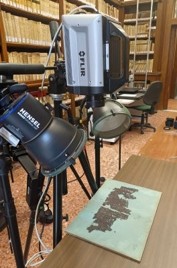
flir 1 2

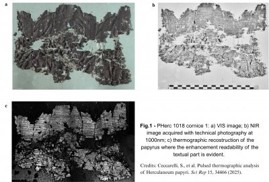
Flir thermal imaging technology is helping researchers in Italy unlock hidden text from the Herculaneum papyri, a unique collection of ancient manuscripts carbonized during the eruption of Mount Vesuvius in 79 AD. Using pulsed thermography that leverages the 2.775 MHz fast analog lock-in input port offered by advanced Flir thermal imaging cameras, scientists are recovering writing previously invisible to the naked eye while also gaining new insight into the fragile internal structure of the documents. All images are sourced from S. Ceccarelli et al., SciRep 15, 34466 (2025).

The vital project is being led by researchers at the Institute of Heritage Science, part of the National Research Council of Italy (CNR), who are exploring non-destructive ways to study and preserve what remains the only surviving library from the ancient Greco-Roman world.

Discovered during excavations in the 18th century at the Villa dei Papiri in Herculaneum, the scrolls survived the volcanic eruption through carbonization caused by intense heat and burial beneath volcanic material.

Picture2

While this extraordinary process preserved the manuscripts, it also created major challenges for historians and conservators attempting to read and protect them.

Many of the papyri were mechanically unrolled centuries ago and mounted to supporting boards. However, the resulting fragments are extremely fragile, often heavily layered, and in many cases almost unreadable.

Conventional Imaging Falls Short

One of the principal challenges facing researchers is that both the carbonized papyrus substrate and the ink are black, making differentiation extremely difficult using conventional imaging methods as the contrast in the visible range is lost. Other more sophisticated techniques like X-ray can work, particularly in combination with artificial intelligence, but are more complex and expensive, requiring transportation of the papyri to special labs where these techniques are available.

To address these challenges, conservators turned to pulsed thermography, a technique that combines controlled light excitation with high-speed thermal imaging. The method works by illuminating the papyrus

with a short pulse of light and recording the resulting thermal response over time.

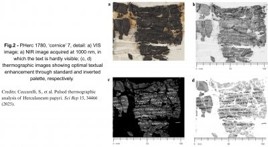
Surface inscriptions become visible almost immediately in the first few infrared frames after excitation because the ink absorbs light differently to the surrounding papyrus material. As heat propagates through the sample over the following seconds, deeper structural details and underlying features begin to emerge. This time-based thermal behavior provides researchers with a way to distinguish writing from substrate material.

Advanced Thermal Imaging

Central to the project is the use of Flir X-Series thermal imaging cameras. Combining high-speed, high-sensitivity infrared imaging with advanced thermal management capabilities, the cameras are ideal for scientific and research environments where precision and data integrity are vital.

Operating in the mid-wave infrared spectrum, Flir X-Series cameras enabled researchers to capture rapid thermal events with exceptional sensitivity, allowing subtle temperature differences between inked and non-inked areas of the papyri to become visible during pulsed thermography analysis. The X-Series features a fast analog lock-in input port designed to receive external reference signals, enabling high-speed thermal analysis at a sampling rate of 2.775 MHz. This capability allows researchers to detect faint signals or minute temperature differences in materials.

The researchers used dual flash lamps to generate controlled excitation while limiting temperature increases within the papyri to 2-3°C, well below any level considered harmful to the ancient material. Special filtering systems also prevented ultraviolet exposure and minimized unwanted infrared reflections.

According to the project team, the high sensitivity, spatial resolution and advanced recording capabilities of the Flir X-Series proved particularly important when identifying fine thermal contrasts and preserving image clarity throughout the acquisition process.

The ability to stream and record thermal data continuously without dropped frames also supported detailed post-processing and analysis using Flir Research Studio software.

Notably, the method remains entirely non-contact and non-destructive, a critical requirement when working with fragile cultural heritage artefacts that cannot be physically manipulated or removed from their historical supports.

Picture3

Beyond Text Recovery

While the primary objective of the project involves revealing hidden text, pulsed thermography also provides

valuable structural information for conservation specialists.

As heat diffuses through the papyrus over longer timescales, the thermal data begins to reveal features such as fiber patterns, overlapping layers, and adhesion points between the papyrus and its supporting board.

These details help conservators better understand the physical condition of the manuscripts and identify areas where deterioration or detachment may be occurring.

The ability to investigate both writing and substrate morphology from the same thermal dataset provides significant advantages for restoration planning and long-term preservation strategies. The technique is particularly useful because some regions of the manuscripts contain multiple compressed layers created during the historical unrolling process. In these areas, underlying sections remained attached rather than separating cleanly, creating a complex structure that is difficult to analyze using traditional imaging methods.

The researchers also noted that some competing technologies can involve bulkier equipment, more restrictive positioning requirements, or lower image definition when examining layered material.

Future Potential

One of the remaining challenges involves identifying text located on the reverse side of the papyri or buried within heavily layered sections where only limited excitation light can penetrate. Although possible to detect residual thermal information from deeper layers, the resulting signals become increasingly weak and blurred as heat diffuses through the material.

To help overcome these limitations, the CNR team is now exploring the use of AI-based processing techniques. AI-assisted analysis could further enhance differentiation between the ink and the papyrus substrate, potentially improving readability and supporting future interpretation of the texts.

Whatever the future holds, the team is confident that pulsed thermography is set to become an increasingly valuable complementary tool alongside other advanced heritage science techniques. This exciting project has demonstrated the growing role of Flir thermal imaging technology in scientific research and preservation. By combining high-speed thermal acquisition with advanced analysis methods, researchers are now able to study some of the world’s most fragile historical artefacts in ways that were previously impossible.

www.flir.com


AI-Ready Manufacturing: AC4DC Software Winner of the Factory Innovation Award 2026 - Independent Jury praises scalable data platform:

  • ,Far beyond simple connectivity: prepares data based on context for AI tools´
  • ,Significantly reduced hardware requirements´ (up to 80% of the costs)
  • ,Perfect for discrete manufacturing, automotive, and mechanical engineering´
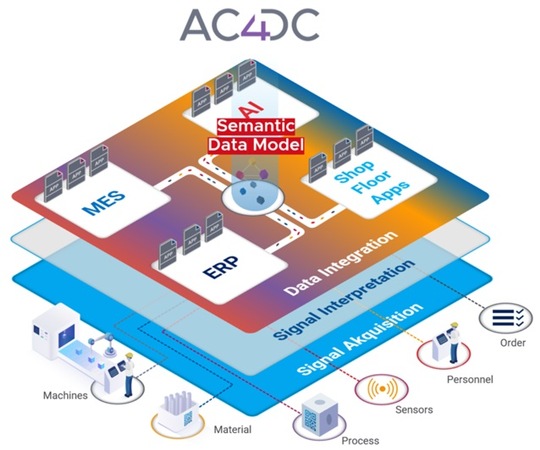
AI-ready data, reduced hardware costs, ideal for the automotive and mechanical engineering industries: The AC4DC software has been awarded the Factory Innovation 2026 in Bronze—the highest rating in the "Connectivity and Interfaces" category this year—Graphic: FORCAM ENISCO

Böblingen/Hanover (Germany), June 2026 – The factory software solution AC4DC by FORCAM ENISCO has won the prestigious Factory Innovation Award 2026. It took the prize in the "Connectivity and Interfaces" category.

An independent Jury of 16 experts from industry and science awarded the Bronze medal. No Gold or Silver awards were given in this category this year. Therefore, Bronze is the highest possible rating. What the jury liked most about AC4DC:

  • Unified Industrial Namespace and semantic harmonization: The platform creates a common language for different machines and data systems. It prepares data based on context for AI tools. This goes far beyond simple connectivity.
  • Super fast and easy connection: Assets can be linked in just a few minutes using ready-made templates. Users can create their own templates. The whole setup takes less than 2 hours.
  • High cost savings and growth: Significantly reduced hardware requirements with mini-PCs. The system offers high availability, version control, and good security. It is perfect for discrete manufacturing, automotive, and mechanical engineering.

(Source : Factory Innovation magazine, 3/2026)

Marc-André Fröschl, Head of Product Management at FORCAM ENISCO: "We are very happy about this award. Well-known industrial clients already use AC4DC. Our software helps integrate machine and production data fast. This allows for data-driven manufacturing and AI apps."

The publisher GITO Media organizes the Factory Innovation Award. It is one of the most important prizes for smart factory software in Europe. The award ceremony took place at the Hannover Messe 2026.

Platform for Industrial Data Management

AC4DC is a scalable data platform for industrial data management. The solution blends and standardizes production data from factory floor and management systems. This includes everything from machines to MES and ERP software.

Marc Fröschl: "The data comes together in a clear production data model. It is ready in real time across different sites and systems. AC4DC builds the foundation for data-driven production apps, industrial AI use cases, and modern automation."

Key Features of the AC4DC Solution

  • Great transparency through a single and reliable view of production
  • Up to 80% lower hardware costs by using industrial micro-PCs
  • Highly available data for real-time analytics, automation, and AI systems (data buffering)
  • Faster global rollouts through template-based setups
  • Better cybersecurity through data encryption at the machine level
  • Flexible deployment as an edge or cloud solution
  • Support of open standards like OPC UA, MQTT, and NATS

Use Case: Efficient Machine Data Integration

FORCAM ENISCO recently showed with partners how AC4DC helps use industrial AI in real life.

AC4DC offers easy machine data integration together with a solution from the company machinetalk. AC4DC provides the scalable data space. machinetalk manages key engineering steps to connect the machines.

This combined workflow digitizes machines faster. Production data goes straight to MES, AI models, or IoT platforms. Companies benefit from:

  • less manual engineering work
  • higher data quality
  • faster project results
  • quicker return on investment

Use Case: Voice-Based Data Use with AC4DC and AI Agents

Proven factory tech combined with voice recognition via AI agents is the approach of AC4DC and the IT expert 4IoT.

  • AC4DC connects factory machines reliably to the digital world.
  • 4IoT ensures that the SAP BTP Cloud stores data safely and flexibly. This is GDPR-compliant and scalable.
  • Companies choose their own AI provider freely, such as SAP AI Core or OpenAI. There are no dependencies.
  • Voice control allows users to ask for production data, analyze it, and send commands back just by speaking.
  • The result is real AI agents for manufacturing. Factory teams ask questions, and the production plant answers directly.

Foundation for Scalable Industrial Connectivity

With the Factory Innovation Award 2026, AC4DC shows its role as an innovative provider for modern industrial data management. The solution helps companies use their production data well. It is scalable, secure, and ready for the future.

Subcategories

Share This

1 2 3 4 5 6 7 8 9 10 11 11