Manufacturing Production Solutions

Rethinking Production – Between Generations and AI

When Experience Retires, Industry 5.0 Provides the Answer

A quiet gap is emerging in many manufacturing facilities: with every experienced employee, accumulated knowledge disappears from the shop floor, i.e. the direct production level. What is lost is not labour, but the experiential knowledge built up over years: how to handle machinery, processes, and disruptions. At the same time, Generation Z, with its digital fluency and quick comprehension, encounters a production reality shaped by hands-on experience. This widens the gap between digital competence and lived process practice. New approaches aim to address this by systematically harnessing experiential knowledge and reintroducing it into daily production through digital assistance systems.

Recent developments in the UK labour market highlight this emerging trend. The PwC Global Workforce Hopes & Fears Survey 2025 reveals a Generation Z that is motivated and tech-savvy but holds higher expectations for development opportunities and workplace quality, whilst considering job changes more frequently. At the same time, the AI Labour Market Survey 2025 by the UK Department for Science, Innovation and Technology points to significant AI skills gaps in businesses, particularly in practical industrial applications.

Industry 5.0 directly addresses this challenge. Its focus is not on pure automation but on collaboration between humans and machines, where experience and technology reinforce each other.

BoomerZ: Preserving Production Knowledge

One such approach is BoomerZ, developed by DE software & control GmbH, a provider of production software and AI-powered shop floor systems. The project shifts knowledge transfer from theory into ongoing production, making experiential knowledge directly visible in the process. Experienced workers remain actively involved in manufacturing, while younger employees accompany them and digitally document processes.

The goal is not just to capture visible workflows but, crucially, implicit knowledge, e.g. how machines are adjusted in response to deviations, or which solutions have proven effective in practice. Artificial intelligence then structures this information into usable knowledge blocks. From videos, speech, and observations, step-by-step instructions are created for future use.

Another objective is to foster mutual understanding between these very different generations, break down prejudices, and encourage learning from one another. BoomerZ facilitates  

interaction and exchange, allowing diverse experiences, perspectives, and skills to be shared – both professionally and socially.

Digital Assistance on the Shop Floor

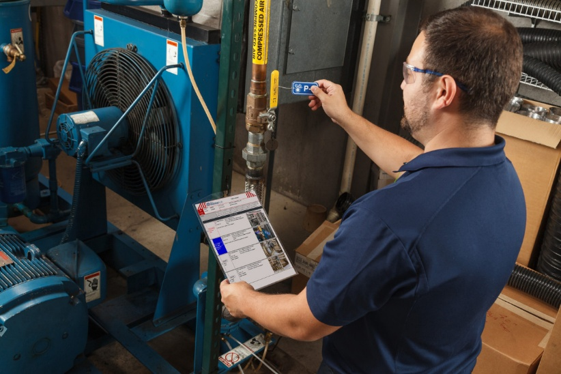
To ensure that the knowledge of older workers directly impacts daily operations, workplace assistance systems are essential. One example is workstAItion 5.0, which supports Industry 5.0 directly in production. The system leverages existing work instructions and company knowledge, using AI to prepare and contextualise them. Employees receive task-, experience-, and language-specific information at their workstations – delivered as text, images, videos, or interactive queries.

This is complemented by AI-powered assistance functions that transform the workplace into an interactive knowledge hub. Employees can ask questions, clarify uncertainties, or provide feedback when the content does not match real-world conditions. This creates continuous exchange between production and the knowledge system. Combined with technologies like camera systems, pick-by-light, or digital verification mechanisms, errors can be detected early, and processes stabilised. Knowledge becomes available precisely when needed, directly within the workflow.

Conclusion

Industry 5.0 thus represents not so much a technological rupture as a shift in perspective. The decisive factor is not technology alone but the integration of experiential knowledge, digital competence, and AI-driven support into a unified production system.

https://www.de-group.net/en/worker-assistance/

de logo blue10x

Stratasys Advances Rail-Ready Additive Manufacturing with Certified Flame-Retardant FDM Material

STRP059 Stratasys PA6 66 rail handle train

Stratasys Ltd. (NASDAQ: SSYS) today announced the launch of FDM® PA6/66‑GF30‑FR, a new flame‑retardant composite material designed to enable rail and transportation manufacturers to produce certified end‑use parts and critical spare parts. The new material expands Stratasys’ portfolio of industrial-grade, rail‑ready FDM thermoplastics and is engineered specifically for use on Fortus® 450mc and F900® systems.

Developed in response to long‑standing collaboration with railway OEMs and service providers, the new material addresses a clear market need for certified, production‑ready additive manufacturing solutions that balance compliance, performance, and total cost of ownership. It meets EN 45545‑2 HL2 (R22/R23) and FMVSS 302 fire safety requirements, delivering high stiffness and strength suitable for load‑bearing, functional rail applications. Customers benefit from the durability, performance, and quality associated with Stratasys‑certified parts.

Designed for production environments, the material offers reliable printability, excellent surface finish, and repeatable part quality. Its flame‑retardant PA 6/66 base polymer is reinforced with 30% glass fiber, delivering stronger and stiffer performance than PC‑FR alternatives and positioning it competitively around materials such as ULTEM™ 9085 resin. Compatibility with SUP4050B breakaway supports enables efficient post‑processing and throughput for end‑use parts.

“With Stratasys, we can implement additive manufacturing in a controlled, certifiable way, which is essential for the rail industry,” said Lorenzo Gasparoni, 3D Printing Program Manager, Alstom Group. “FDM PA6/66‑GF30‑FR supports reliable, repeatable production of qualified spare parts, along with streamlined, easy support removal using SUP4050B. The surface finish is exceptional and directly reflects the quality and performance of the parts.”

Rail and transportation manufacturers are increasingly adopting additive manufacturing to support production of on‑demand spare parts, reducing lead times and lowering inventory costs, particularly across long‑life assets and maintenance operations.

“At Siemens Mobility, we see additive manufacturing as a key enabler of flexible production in the railway industry,” said Christian Ochs, Head of Additive Manufacturing, Siemens Mobility GmbH. “Its ability to produce complex, application‑specific parts on demand supports more efficient maintenance, reduces lead times, and enhances lifecycle management across rail systems.”

“Stratasys is strategically focused on mobility, transportation, automotive, and industrial applications, where our high-end additive manufacturing solutions have a real advantage in meeting production and certification requirements. The launch of FDM® PA6/66‑GF30‑FR demonstrates our excellence in design for mobility applications,” said Rich Garrity, Chief Business Unit Officer at Stratasys. “By expanding our rail‑certified FDM materials portfolio, we’re enabling customers to scale additive manufacturing with greater flexibility and confidence, while producing parts when and where they’re needed.”

FDM® PA6/66‑GF30‑FR is generally available for Fortus® 450mc and F900® systems. Additional specifications and supported applications are available on the product page: https://www.stratasys.com/en/materials/materials-catalog/fdm-materials/fdm-pa6-66-gf30-fr/

QUECLINK LAUNCHES INDUSTRIAL 4G ROUTER PLATFORM FOR SMART MANUFACTURING AND FACTORY AUTOMATION

Queclink Wireless Solutions, a global provider of IoT devices and hardware, has launched a 4G LTE router platform that allows manufacturers to achieve real-time control of automated processes and advanced robotic systems. Alongside advanced wireless connectivity, the WR220 Series delivers expanded flexibility through PoE-powered operation, broader accessory integration and enhanced interface options.

“WR220 is an industrial networking solution that enables manufacturers to transform traditional production environments into intelligent, automated and data-driven facilities,” explains Vernon Bonser, International Sales Director at Queclink Wireless Solutions. “The router has been developed to provide a digital backbone for smart factory operations that enable the seamless integration of robots, production systems and ancillary equipment within the factory environment.”

Built for demanding deployments and harsh environments, the WR220 features an industrial-ready and compact design with a rugged aluminium enclosure, wide operating temperature range, and broad power input support. It also delivers stable wireless connectivity with 4G LTE Cat 4, dual SIM redundancy and intelligent failover mechanisms to maintain network availability across distributed sites, while remote management allows centralised monitoring, configuration and diagnostics.

The WR220 router combines networking, interfacing and wireless technologies in one compact platform to simplify deployment and reduce additional gateways or hardware requirements. This allows the industrial router to bridge legacy operational technology and modern cloud systems within a single architecture, creating a unified, interconnected manufacturing ecosystem. Meanwhile, the router’s built-in BLE gateway allows direct connection with wireless sensors, beacons and edge devices.


PoE PD support has been added to Queclink’s router offering for the first time, enabling the WR220 to receive both power and data delivery through a single Ethernet cable and making the WR220 ideal for space-constrained locations. It will streamline cabling requirements and deployment costs, especially in locations where dedicated power wiring is difficult.

“We have designed the WR220 for businesses requiring a highly adaptable router that delivers reliable industrial connectivity, flexible device integration and simplified deployment across distributed environments. As a result, we believe it will support the digital transformation goals of modern manufacturing and smart factories,” adds Bonser.

NMIS 5G trial explores future of industrial connectivity in Ayrshire

A collaborative project at the National Manufacturing Institute Scotland’s (NMIS) Digital Process Manufacturing Centre (DPMC) in Irvine has demonstrated how private 5G mobile networks could support growing demand for secure, high-capacity connectivity in modern manufacturing.

Interest in 5G within manufacturing continues to grow, driven by the need for faster and more secure connectivity to support increasingly data-driven production systems. However, many organisations remain uncertain about how the technology will perform in real operational environments.

To address this, the project simulated a manufacturing use case and tested network performance under increasing demand in a controlled, factory-like setting. Funded in part by the Department for Science, Innovation and Technology’s 5G Innovation Programme in Ayrshire, it brought together experienced teams from NMIS, Merck, North Ayrshire Council and Folk Consulting.

The trial used a private 5G mobile network deployed at the DPMC, where engineers developed a simulated plant room environment based on Merck’s industrial processes. The setup was designed to replicate common manufacturing equipment, including pumps, fans and control systems, without relying on live operational data.

Working alongside Folk Consulting, NMIS designed the data generation approach and validated the flow of information through the network to ensure it reflected industrial conditions.

The system was then tested under progressively increasing loads, reaching an average data throughput of more than 97 megabits per second (Mbps), with peaks above 100 Mbps. The results suggest the system could support hundreds of simulated industrial environments simultaneously.

As manufacturers adopt more connected systems and data-driven processes, demand for secure and reliable wireless connectivity is expected to rise. The findings provide practical insight into how private 5G networks perform under manufacturing-style conditions and help reduce uncertainty around uptake of the technology.

The project also established a repeatable testing approach that manufacturers could use to benchmark private 5G performance against existing connectivity systems before committing to future investment. It further highlights the role of the DPMC as a practical test environment where manufacturers can better understand emerging digital technologies before committing to large-scale deployment.

Ross Miller, senior engineer at the DPMC, said: There’s a lot of discussion around what 5G could mean for manufacturing, but far less clarity on how it performs in practice.  By 

testing a realistic industrial scenario, we’ve been able to demonstrate how private 5G could support future manufacturing environments and help businesses better understand the opportunities it could offer.”

Merck supported development of the industrial use case used during the trial, drawing on its experience operating complex manufacturing facilities globally. Already an active user of advanced wireless connectivity, the company approached NMIS, which is operated by the University of Strathclyde and part of the High Value Manufacturing (HVM) Catapult, to explore how 5G might support its next phase of digital development.

The Ayrshire 5G Innovation Region forms part of the wider Ayrshire Growth Deal and aims to support regional adoption of advanced connectivity technologies through industry collaboration, infrastructure development and skills activity.

Louise Kirk, director (regional economy) at North Ayrshire Council, said: This project demonstrates what can be achieved when industry and the public sector work together with a shared purpose. By creating an environment where businesses can test and explore technologies like 5G in a controlled, practical way, we can build confidence locally and attract the investment needed to support the infrastructure required for the next generation of manufacturers.”

Jack Waland, 5G specialist at Folk Consulting, added: This project demonstrated how private 5G could support secure and reliable connectivity within manufacturing environments. The work provides a practical model that manufacturers can use to better understand how the technology could support future operations.”

Subcategories

Share This

1 2 3 4 5 6 7 8 9 10 11 11